HaribaskarAI Engineer

Speaking & workshops

Hands-on AI workshops that end with something that works

I run full-day, industry-focused workshops on MLOps, RAG, LLM fine-tuning, agentic AI and LLMOps, for engineering teams, universities and developer communities. Every session is built around labs, so participants leave having built something, not just having seen slides.

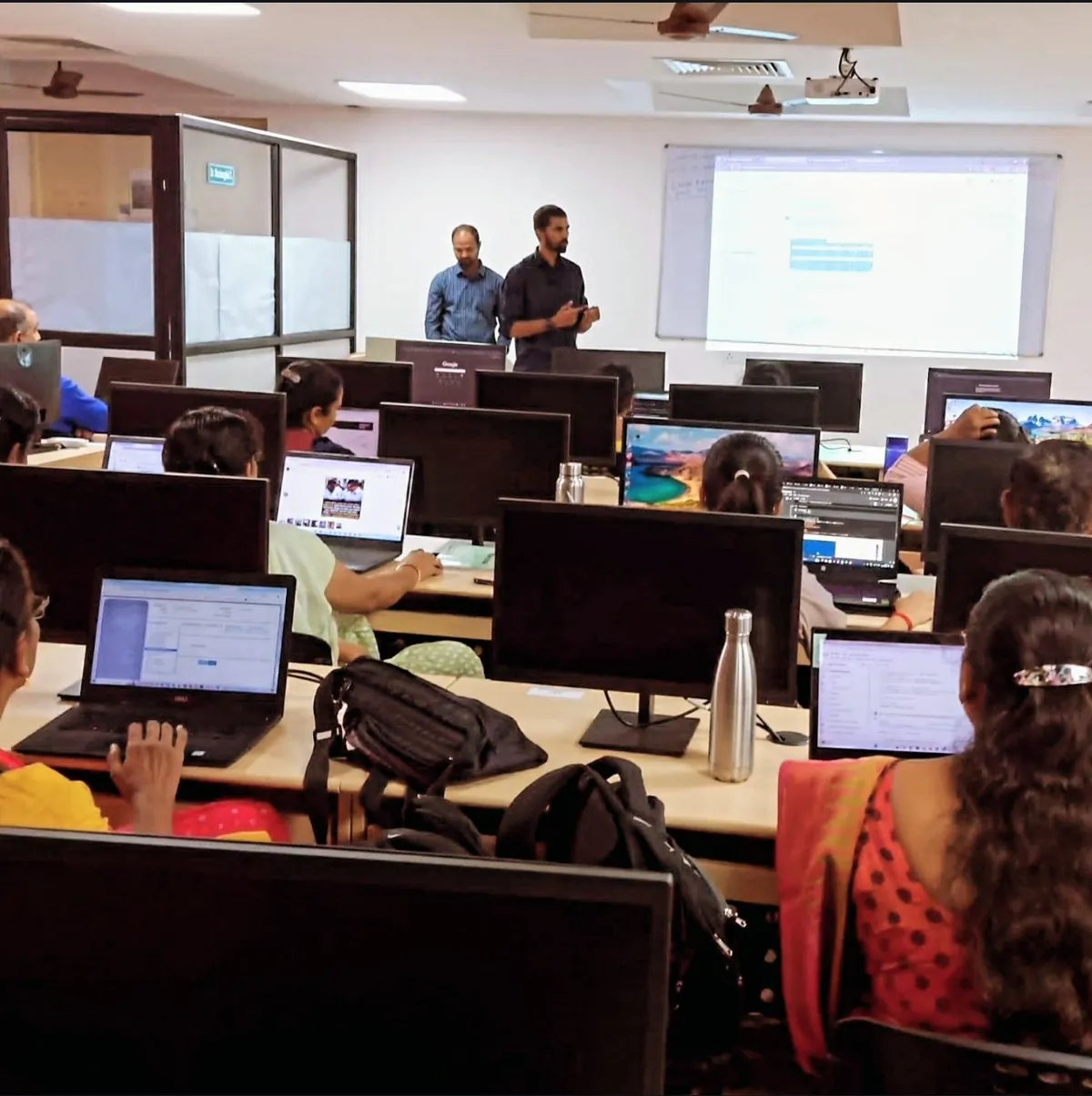
Latest workshop

Topics

What I can teach

Open a topic to see what each session covers.

  • MLOps: from local training to production and beyond

    Take a model from a notebook to a monitored production service, and keep it healthy after launch.

    Full day

    What we cover

    1. Session 1Reproducible training
      • Why models that work locally fail in production
      • Data and code versioning
      • Experiment tracking and a model registry with MLflow
    2. Session 2Packaging and serving
      • Serving a model as a FastAPI service
      • Containerising with Docker
      • CI/CD pipelines for ML: tests, builds and promotion between environments
    3. Session 3Deploying to the cloud
      • Batch vs real-time inference
      • Scaling, versioned releases, canary rollouts and rollback
    4. Session 4After production
      • Monitoring model and data quality
      • Data drift and concept drift
      • Retraining triggers and closing the feedback loop

    Hands-on labs

    • Train and track a model locally, then register the best run
    • Wrap it in an API, containerise it and deploy it through a CI/CD pipeline
    • Capstone: simulate drift, catch the alert, retrain and redeploy

    You leave with: A model running in production with monitoring and an automated retraining loop.

  • Production RAG: building retrieval that works

    Build retrieval-augmented generation that gives grounded, cited answers on real company documents.

    Full day

    What we cover

    1. Session 1How RAG works
      • Embeddings and vector databases
      • The pipeline from ingestion to answer
      • Where naive RAG breaks
    2. Session 2Better retrieval
      • Chunking strategies and metadata
      • Hybrid search (keyword + vector)
      • Reranking and query rewriting
    3. Session 3Better answers
      • Grounding, citations and "I don't know"
      • Document-level access control
      • Handling tables, PDFs and long documents
    4. Session 4Evaluation and production
      • Retrieval and answer metrics
      • Keeping the index fresh
      • Latency and cost

    Hands-on labs

    • Build a baseline RAG pipeline over a realistic document set
    • Add hybrid search and reranking, and measure the difference
    • Capstone: improve the baseline and prove it with evaluation scores

    You leave with: A document Q&A system with citations and an evaluation set that shows each improvement.

  • LLM fine-tuning: when to do it and how

    Decide when fine-tuning beats prompting or RAG, then fine-tune, evaluate and serve an open model.

    Full day

    What we cover

    1. Session 1When to fine-tune
      • Prompting vs RAG vs fine-tuning
      • Choosing a base model
      • Setting a baseline before training
    2. Session 2Preparing data
      • Instruction and chat formats
      • Cleaning and deduplication
      • Synthetic data and building a held-out evaluation set
    3. Session 3Training efficiently
      • Full fine-tuning vs LoRA and QLoRA
      • Key hyperparameters
      • Training on a single GPU
    4. Session 4Evaluating and serving
      • Comparing against the base model
      • Merging adapters, quantisation and inference servers

    Hands-on labs

    • Prepare a domain dataset and an evaluation set
    • Fine-tune a small open model with LoRA on a cloud GPU
    • Capstone: benchmark the fine-tuned model against prompting the base model

    You leave with: A fine-tuned model, a clear comparison with the base model, and a recipe to repeat it.

  • Agentic RAG with reasoning

    Agents that plan, search several sources, check their own answers and retry when retrieval falls short.

    Full day

    What we cover

    1. Session 1From RAG to agents
      • The agent loop and tool calling
      • When an agent is worth the extra cost and complexity
    2. Session 2Reasoning and planning
      • Breaking down complex questions
      • Routing to the right source
      • ReAct-style reasoning loops
    3. Session 3Self-correction
      • Grading retrieved results
      • Re-querying and answer verification
      • Short- and long-term memory
    4. Session 4Making it safe
      • Guardrails and human approval checkpoints
      • Cost and step limits
      • Tracing every step

    Hands-on labs

    • Turn a single-step RAG pipeline into an agent with retrieval tools
    • Add planning, result grading and automatic retries
    • Capstone: answer questions that need several lookups across sources, with a full trace

    You leave with: An agentic RAG system that handles multi-step questions and shows how it got its answer.

  • LLMOps: evaluation, observability and guardrails

    Run LLM applications in production with evals, tracing, caching and guardrails, so every change is measured.

    Full day

    What we cover

    1. Session 1Evaluation
      • Building test sets
      • LLM-as-judge and its pitfalls
      • Automated evals in CI
    2. Session 2Observability
      • Tracing LLM calls and agent steps
      • Logging prompts and responses safely
      • Cost and latency dashboards
    3. Session 3Performance
      • Prompt and semantic caching
      • Model routing, rate limits and fallbacks
    4. Session 4Guardrails
      • Hallucination controls
      • Prompt-injection defences
      • PII handling and responsible-AI practices

    Hands-on labs

    • Add an eval suite and tracing to an existing LLM app
    • Add caching and guardrails, and measure the cost and latency impact
    • Capstone: ship a change, let the evals catch the regression, then fix it

    You leave with: An LLM app with evals, tracing, caching and guardrails that catch problems before users do.

Format

How a workshop works

  1. One full day, shaped around your team

    Four sessions from 9:30 to 5:00. We agree the goals and level first, so it fits your engineers, faculty or students.

  2. Hands-on from the first hour

    Short explanations followed by guided labs, with everyone working on their own machine.

  3. Leave with something that works

    Labs build on each other into one project participants can take back to their work.

Invite me

Bring a hands-on AI workshop to your campus or team

Workshops, faculty development programmes and guest lectures, shaped around your audience and goals.

Send me a message with:

  • Who the audience is and their level
  • The topic or outcome you have in mind
  • A rough date, and in person or online

Not connected yet? Send a connection request with a short note.